
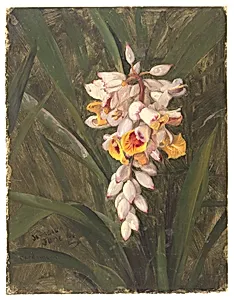
Cardamom, Jamaica
Classification
nature studies
Department
Smithsonian Collection
Museum
Smithsonian American Art Museum
Credit
Gift of Louis P. Church
Accession Number
1917-4-676-b
Rights
Public Domain
About this artwork
Research in Progress
Art Historical Context
**Cardamom, Jamaica** by Frederic Edwin Church captures the lush vibrancy of tropical nature through the artist's keen eye for detail. Painted in June 1865 during Church's recuperative journey to Jamaica amid personal health struggles following the Civil War era, this nature study exemplifies his fascination with exotic flora. As a master of the Hudson River School—a 19th-century American movement celebrating the sublime beauty of the natural world—Church documented cardamom plants with scientific precision, blending Romantic idealism with empirical observation. Though the medium remains unidentified, the work's classification as a nature study highlights Church's preparatory sketches, which informed his monumental landscapes like *Heart of the Andes* (1859). These intimate studies reveal his technique of layering light and texture to evoke the humid, verdant intensity of Jamaican ecosystems, underscoring themes of exploration and renewal in post-war America. Housed in the Smithsonian American Art Museum as a gift from Louis P. Church, this piece invites visitors to appreciate how Church's travels bridged art and botany, offering a window into 1860s Caribbean biodiversity and the era's growing interest in global natural wonders. Research continues to uncover more about its creation, enriching our understanding of Church's prolific output.