
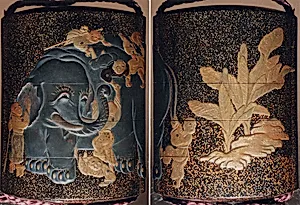
Case (Inrō) with Design of Blind Men Climbing all over Elephant Beside Banana Plants
Unknown Artist
19th century
Medium
Lacquer, roiro, nashiji, silver, gold and colored hiramakie, takamakie; Interior: nashiji and fundame
Dimensions
3 3/16 x 2 5/16 x 13/16 in. (8.1 x 5.9 x 2.1 cm)
Classification
Inrō
Culture & Period
Japan · Edo (1615–1868) or Meiji period (1868–1912)
Department
Asian Art
Museum
Metropolitan Museum of Art, New York, NY
Credit
Rogers Fund, 1913
Accession Number
13.67.65
Rights
Public Domain
Tags
Art Historical Context
This exquisite *inrō*, a traditional Japanese lacquer case from the 19th centurylikely Edo or early Meiji period), served as a portable container for medicines, seals, or tobacco, suspended from the belt by a cord. Measuring just over 3 inches tall, its compact form made it a fashionable accessory for samurai, merchants, and elites during Japan's Edo era (1615–1868), when such items evolved from practical tools into status symbols showcasing artisanal virtuosity. The design depicts blind men clambering over an elephant amid banana plants—a vivid allusion to the ancient parable of the blind men and the elephant, symbolizing subjective perceptions and philosophical insight rooted in Buddhist teachings. Crafted with masterful lacquer techniques, the exterior features glossy *roiro* black lacquer, shimmering *nashiji* pearl ground, and intricate *hiramakie* (flat gold) and *takamakie* (raised gold) inlays with silver, gold, and colored accents, creating texture and depth. The interior's *nashiji* and *fundame* grounds add subtle luxury. Acquired by The Metropolitan Museum of Art in 1913 via the Rogers Fund, this *inrō* exemplifies Japan's *urushi-e* tradition, where layers of lacquer were meticulously applied, sprinkled with metal powders, and polished to jewel-like perfection—a testament to the anonymous artisan's skill and the cultural fusion of utility, humor, and wisdom.