
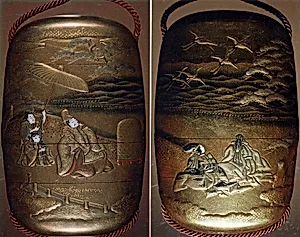
Case (Inrō) with Design of Minamoto no Yoritomo and Courtiers Watching Released Cranes Fly Away at Akanumagahara
Unknown Artist
19th century
Medium
Gold and silver maki-e with gold lacquer Ojime: Stone in the shape of a melon, 19th century Bequest of Stephen Whitney Phoenix, 1881 81.1.424.85 Netsuke: Ivory in the shape of a deer, 19th century Gift of Mrs. Russell Sage, 1910 10.211.510
Dimensions
H. 3 3/8 in. (8.6 cm); W. 2 3/16 in. (5.6 cm); D. 13/16 in. (2 cm)
Classification
Inrō
Culture & Period
Japan · Edo period (1615–1868)
Department
Asian Art
Museum
Metropolitan Museum of Art, New York, NY
Credit
Bequest of Stephen Whitney Phoenix, 1881
Accession Number
81.1.337
Rights
Public Domain
Tags
Art Historical Context
This exquisite 19th-century Japanese *inrō*—a lacquered case worn suspended from the belt to carry medicines, seals, or tobacco—captures a poetic moment from history: Minamoto no Yomo, the founder of Japan's first shogunate in the 12th century, and courtiers watching released cranes soar over Akanumagahara plain. Crafted during the late Edo period (161–1868), when such portable art forms flourished among samurai and merchants, the design celebrates themes of freedom, longevity, and good fortune, as cranes were revered symbols in Japanese culture. The case gleams with masterful *maki-e* technique, where artists sprinkled fine gold and silver powders onto wet gold lacquer to form intricate, raised designs of figures and birds. Measuring just 3⅜ inches tall, it pairs with a melon-shaped stone *ojime* (a sliding bead to secure the cords) and an ivory *netsuke* carved as a deer, evoking nature's harmony. These bequests to the Metropolitan Museum of Art highlight the West's growing fascination with Japanese artistry in the 19th century. As a functional yet opulent accessory, this *inrō* ensemble reflects Edo-era craftsmanship, blending utility with storytelling to evoke the elegance of warrior nobility.