
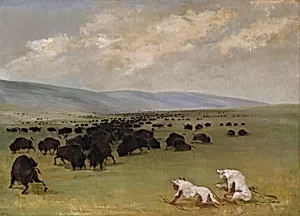
Catlin and His Indian Guide Approaching Buffalo under White Wolf Skins
1846-1848
Medium
Painting
Classification
Painting
Department
Smithsonian Collection
Museum
Smithsonian American Art Museum
Credit
Smithsonian American Art Museum, Gift of Mrs. Joseph Harrison, Jr.
Accession Number
1985.66.590
Rights
Public Domain
Tags
About this artwork
George Catlin and the Indian guide, covered in wolf skins and with weapons at the ready, creep up on a herd of buffalo. The artist painted several versions of this theme, inspired by his lament that “the poor buffaloes have their enemy man, besetting and besieging them at all times of the year and in all the modes that man . . . has been able to devise for their destruction. They struggle in vain to evade his deadly shafts . . . While the herd of buffaloes are together, they seem to have little ...
Art Historical Context
In this vivid 1846-1848 painting, George Catlin depicts himself alongside an Indian guide as they stealthily approach a herd of buffalo, both men concealed beneath white wolf skins with weapons ready. The scene captures a traditional hunting method in which crawled on hands and knees, mimicking wolves to get within close range of unsuspecting animals. As Catlin noted in his writings, buffalo showed little fear of wolves, allowing this clever disguise to succeed where other approaches failed. Catlin, a pioneering American artist and ethnographer, created several versions of this subject during his extensive travels documenting Native American life and the rapidly disappearing buffalo herds of the Great Plains. The work reflects his deep respect for indigenous hunting knowledge while highlighting the intense pressure these animals faced from human hunters using ever more destructive techniques. Housed in the Smithsonian American Art Museum, this self-portrait offers viewers a rare firsthand glimpse into mid-19th-century Western life and Catlin’s commitment to preserving visual records of cultures and wildlife he feared would soon vanish.
About the Artist
George Catlin · 1796–1872
George Catlin (1796–1872), born in Wilkes-Barre, Pennsylvania, to Putnam Catlin and Polly Sutton—who had been captured by Native Americans during the 1778 Battle of Wyoming—initially pursued a legal career. Trained at Litchfield Law School, he was admitted to the bar in 1819 but abandoned law after two years to study art in Philadelphia in 1823. Self-taught as a portraitist, Catlin quickly gained ...