
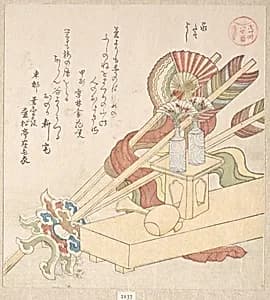
Ceremonial Things for the Celebration of Setting Up a New House
19th century
Medium
Woodblock print (surimono); ink and color on paper
Dimensions
7 7/8 x 7 1/4 in. (20 x 18.4 cm)
Classification
Prints
Culture & Period
Japan · Edo period (1615–1868)
Department
Asian Art
Museum
Metropolitan Museum of Art, New York, NY
Credit
H. O. Havemeyer Collection, Bequest of Mrs. H. O. Havemeyer, 1929
Accession Number
JP2137
Rights
Public Domain
Art Historical Context
Kubo Shunman's *Ceremonial Things for Celebration of Setting Up a House* is a delightful 19th-century woodblock print from Edo period (16151868), a time when urban culture flourished and printmaking became an accessible art form. Created as a *surimono*—a luxurious, privately commissioned print often made for special occasions—this intimate square-format work (7 7/8 x 7 1/4 in.) uses vibrant ink and color on paper to auspicious objects for a housewarming ritual, reflecting the era's emphasis on prosperity and harmony in daily life. Shunman, a versatile artist known for his poetic flair and mastery of ukiyo-e traditions, elevated *surimono* with refined techniques like subtle gradations of color (bokashi) and possibly metallic pigments or embossing for a tactile elegance. These prints were typically produced in small editions for patrons, blending art with personal celebration, unlike mass-market ukiyo-e. In Japanese culture, moving into a new home involved rituals with items symbolizing good fortune, such as rice measures or brooms, underscoring community and Shinto beliefs in warding off misfortune. Housed in the Metropolitan Museum of Art's Asian Art collection (H. O. Havemeyer Collection, 1929), this piece offers a charming window into Edo domestic joys, inviting us to appreciate the artistry in everyday milestones.
About the Artist
Kubo Shunman · 1757–1820
Japanese, 1757–1820