
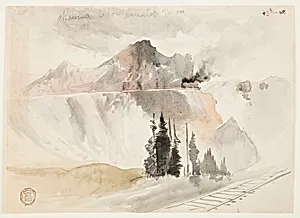
Chama Below the Summit
Classification
landscapes
Department
Smithsonian Collection
Museum
Smithsonian American Art Museum
Credit
Gift of Thomas Moran
Accession Number
1917-17-50
Rights
Public Domain
About this artwork
Landscape with railroad track in lower right foreground; view across ravine, with evergreen tree thicket, to Rocky Mountain range. Glimpse of train with smoke-belching engine, right of center, traversing mountain ridge.
Art Historical Context
Thomas Moran, a British-born American artist (1837–1926) renowned for his luminous landscapes of the American West, the majestic Rocky Mountains in *Chama the Summit* (1892). A leading figure in the Hudson River School tradition, Moran often depicted untamed wilderness with dramatic light and atmospheric depth, drawing from his expeditions with government surveys like those of Yellowstone. This painting, now in the Smithsonian American Art as a gift from the artist himself, showcases his skill in evoking the sublime scale of nature. In the foreground, a railroad track snakes through a ravine thick with evergreens, leading the viewer's eye across to towering peaks. Right of center, a smoke-belching train chugs along a distant ridge, symbolizing the late 19th-century clash between industrial progress and pristine landscapes. Likely inspired by the narrow-gauge railroads piercing Colorado's San Juan Mountains near Chama, New Mexico, the work reflects America's Gilded Age expansion westward, where iron horses tamed the frontier. Moran's composition blends romantic idealism with realism, highlighting humanity's imprint on the wild—a theme resonant during debates over conservation that would birth national parks. Visitors will appreciate how this vista invites reflection on our evolving relationship with the land.