
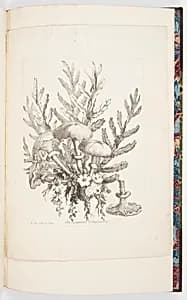
Champignons d'Angleterre
Classification
Department
Smithsonian Collection
Museum
Smithsonian American Art Museum
Credit
Purchased for the Museum by the Advisory Council
Accession Number
1921-6-402-13
Rights
Public Domain
About this artwork
Research in Progress
Art Historical Context
**Champignons d'Angleterre** *Charles-Germain de Saint-Aubin (French, 1721–1786), 1755–68* Etching or engraving (print); Smithsonian American Art Museum during the mid-18th century, *Champignons d'Angleterre ("Mushrooms of") is a delicate print by Charles-Germain de Saint-Aubin a prolific French engraver and illustrator renowned for his intricate Rococo-style works. Active in Paris amid the Enlightenment's fascination with natural history, Saint-Aubin often captured everyday subjects, flora, and fauna with meticulous detail. This piece, dated between 1755 and 1768, reflects the era's growing scientific curiosity about the natural world, where artists like him contributed to botanical studies through precise prints that bridged art and science. As a classified print, the work likely showcases Saint-Aubin's mastery of line work and shading, techniques essential for reproducing fine textures like the caps and gills of fungi. Depicting English mushrooms—a nod to cross-channel exchanges in knowledge and collecting— it highlights Europe's interconnected intellectual circles. Though the exact medium awaits further research, such prints were vital for disseminating discoveries, serving scholars, apothecaries, and collectors. Acquired for the Smithsonian American Art Museum through the Advisory Council, this rare French import enriches the collection's exploration of printmaking's role in documenting nature. With ongoing research, it invites visitors to ponder the humble mushroom's place in artistic and scientific history. (198 words)