
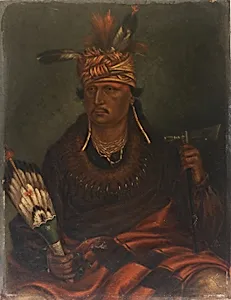
Chetan-woa-kutoa-mang (The Hawk Who Hunts Walking)
Medium
Painting
Classification
Painting
Department
Smithsonian Collection
Museum
Smithsonian American Art Museum
Credit
Smithsonian American Art Museum, Museum acquisition
Accession Number
1985.66.295,541
Rights
Public Domain
Tags
Art Historical Context
**Chetan-woa-kutoa-mang (The Hawk Who Hunts Walking)** a compelling portrait painted around 1887 by Antonion Z Shindler, a Bulgarian artist (1813–9) who settled in Washington, D.C., and became renowned for documenting Native American. This oil painting captures a Sioux man, whose name translates to "The Hawk Hunts Walking," reflecting Lakota naming traditions that evoke strength and prowess in the natural world. Shindler's work, now in the Smithsonian American Art Museum collection, exemplifies the late 19th-century fascination with ethnographic portraiture. Created during a turbulent era for Native American communities—amid U.S. government policies of forced assimilation and reservation life—this portrait preserves the dignity and individuality of its subject. Shindler, employed by the Smithsonian Institution, meticulously rendered facial features, regalia, and expressions, contributing to early anthropological records. His technique emphasized realism, bridging fine art and scientific documentation. Housed in the Smithsonian American Art Museum through museum acquisition, this piece highlights the intersection of art and history, offering visitors a window into Sioux cultural resilience. It's a poignant reminder of how portraits like this countered stereotypes, humanizing Indigenous peoples during a time of profound change.