
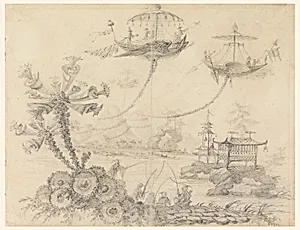
Chinoiserie Fantasy
Classification
graphic design
Department
Smithsonian Collection
Museum
Smithsonian American Art Museum
Credit
Gift of Eleanor and Sarah Hewitt from the collection of Mrs. Abram S. Hewitt
Accession Number
1931-70-29
Rights
Public Domain
About this artwork
Research in Progress
Art Historical Context
Jean-Baptiste Pillement, a prolific French artist of the Rococo era (1728–1808), captures the whimsical spirit of *Chinoiserie Fantasy* in this graphic design from around 1770–90. Chinoiserie, a fashionable European style blending imagined Chinese motifs with lavish ornamentation, exploded in popularity during the 18th amid growing trade with Asia. Pillement, renowned for his intricate etchings, drawings, and textile designs, excelled in these fantastical scenes, often featuring pagodas, exotic birds, and flowing landscapes that evoked an idealized Orient. This work exemplifies Pillement's mastery of decorative arts, influencing wallpapers, ceramics, and furnishings across Europe. Created at the tail end of the Rococo period, it reflects a shift toward lighter, more playful aesthetics before Neoclassicism's rise. As a graphic design, it likely served as a pattern or study, highlighting the era's fusion of fantasy and craftsmanship—perfect for opulent interiors of the aristocracy. Now part of the Smithsonian American Art Museum's collection, gifted by Eleanor and Sarah Hewitt, *Chinoiserie Fantasy* invites visitors to marvel at how 18th-century imagination bridged cultures, turning distant inspirations into tangible elegance. Research continues to uncover more about its creation, adding to its allure.