
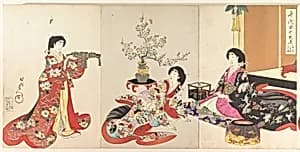
Chiyoda Castle (Album of Women)
Medium
Triptych of woodblock prints; ink and color on paper
Dimensions
L. (page) 13 7/8 in. (35.2 cm); W. (page) 9 1/4 in. (23.4 cm)
Classification
Prints
Culture & Period
Japan · Meiji period (1868–1912)
Department
Asian Art
Museum
Metropolitan Museum of Art, New York, NY
Credit
Gift of Mrs. W. Walton Butterworth, 1979
Accession Number
JP3521
Rights
Public Domain
Tags
Art Historical Context
Step into the elegant world of Meiji-era with *Chiyoda Castle ( of Women)*, a captivating triptych of woodblock prints by Yshū (Hashimoto) Chikanobu, in 1895. This masterpiece from the ukiyo-e tradition—meaning "pictures of the floating world"—showcases Chikanobu's mastery in depicting bijin-ga, or beautiful women, amid the opulent interiors of Chiyoda Castle, the Edo Castle and heart of the shogun's. Printed with vibrant inks and colors on delicate paper (each page measuring 13⅞ × 9¼ inches), the triptych format allows for panoramic storytelling, a hallmark of Japanese printmaking that unfolds scenes across three sheets. Produced during the Meiji period (1868–1912), a time of rapid Westernization and modernization in Japan, this work nostalgically preserves the refined lives of women in the shogun's inner palace, or ōoku. Chikanobu, a prolific artist known for historical and genre scenes, highlights their poise, fashion, and daily rituals, offering a glimpse into a vanishing feudal world just decades after the samurai era's end. The woodblock technique itself is a cultural treasure: intricate carvings on wooden blocks ensured affordable, mass-produced beauty, influencing global artists like Van Gogh. Housed in the Metropolitan Museum of Art's Asian Art Department as a gift from Mrs. W. Walton Butterworth in 1979, this print invites visitors to appreciate Japan's blend of artistry and history—where every kimono fold and subtle expression whispers tales of grace under change.
About the Artist
Yōshū (Hashimoto) Chikanobu · 1838–1912
Toyohara Chikanobu, born Hashimoto Naoyoshi in 1838 in Echigo Province (modern Niigata Prefecture), emerged as one of the last great ukiyo-e masters during Japan's Meiji era. The son of a low-ranking samurai retainer to the Sakakibara clan, he trained initially in the Kanō school of painting before turning to ukiyo-e printmaking. He studied under a disciple of Keisai Eisen, then joined the studio ...