
Chiyoda Castle (Album of Women)
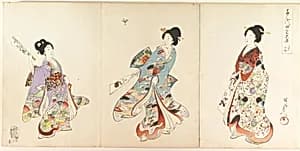
Medium
Triptych of woodblock prints; ink and color on paper
Dimensions
L. (page) 13 7/8 in. (35.2 cm); W. (page) 9 1/4 in. (23.4 cm)
Classification
Prints
Culture & Period
Japan · Meiji period (1868–1912)
Department
Asian Art
Museum
Metropolitan Museum of Art, New York, NY
Credit
Gift of Mrs. W. Walton Butterworth, 1979
Accession Number
JP3525
Rights
Public Domain
Tags
Art Historical Context
Created by Yōshū Chikanobu in 1895, *Chiyoda Castle (Album of Women)* is a striking triptych of woodblock prints that captures elegant women within the historic grounds of Chiyoda Castle, the former Edo Castle and seat of imperial power. Rendered in ink and color on paper, the three panels work together to present a sweeping, harmonious scene typical of Meiji-period ukiyo-e. Chikanobu, a leading print designer of his era, specialized in bijin-ga—images of beautiful women—often blending traditional Japanese aesthetics with subtle nods to the changing society around him. During the Meiji period (1868–1912), Japan underwent rapid modernization while many artists looked back to preserve images of courtly and domestic life. This triptych format, a popular innovation in woodblock printing, allowed Chikanobu to depict expansive interiors or gardens filled with women in layered kimono, highlighting both their grace and the refined rituals of the period. The work reflects a nostalgic appreciation for pre-modern customs even as Tokyo transformed. Housed in the Metropolitan Museum of Art’s Asian Art collection, the prints offer viewers a window into late-19th-century Japanese visual culture. Their delicate color gradations and careful attention to textile patterns demonstrate the enduring technical mastery of the woodblock medium, making the album a cherished example of how art documented and celebrated women’s worlds during a time of transition.
About the Artist
Yōshū (Hashimoto) Chikanobu · 1838–1912
Toyohara Chikanobu, born Hashimoto Naoyoshi in 1838 in Echigo Province (modern Niigata Prefecture), emerged as one of the last great ukiyo-e masters during Japan's Meiji era. The son of a low-ranking samurai retainer to the Sakakibara clan, he trained initially in the Kanō school of painting before turning to ukiyo-e printmaking. He studied under a disciple of Keisai Eisen, then joined the studio ...