
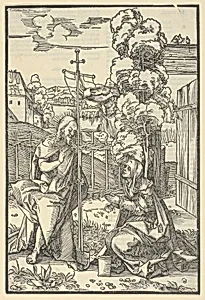
Christ Appearing to Mary Magdalen (Noli Me Tangere), from Speculum passionis domini nostri Ihesu Christi
Medium
Woodcut
Dimensions
Sheet: 9 1/2 × 6 3/8 in. (24.1 × 16.2 cm)
Classification
Prints
Department
Drawings and Prints
Museum
Metropolitan Museum of Art, New York, NY
Credit
Gift of Junius S. Morgan, 1919
Accession Number
19.52.60
Rights
Public Domain
Tags
Art Historical Context
In the early 16th century, Northern Renaissance art flourished in Germany, woodcuts like *Christ Appearing to Maryen (Noli Me Tangere)* from the *Speculum passionis dom nostri Ihesu Christi (Mirror of the Passion of Our Jesus Christ) brought biblical narratives to everyday devotees. Created in 1507, this print captures the poignant post-Resurrection moment from the Gospel of John, where risen Christ gently rebukes Mary Magdalene's attempt to touch him, saying "Noli me tangere" ("Do not touch me"). Attributed to designer Hans Schäufelein—a talented engraver and pupil of Albrecht Dürer—alongside author Ulrich Pinder and publisher Friedrich Peypus, it formed part of a devotional book series meant for meditation on Christ's suffering and triumph. Woodcuts were revolutionary for their affordability and reproducibility, allowing intricate scenes to be mass-produced on paper for homes and churches. Schäufele's precise lines and dramatic composition highlight the emotional intimacy between Christ and Mary, her recognizable flowing hair and ointment jar symbolizing her repentance. Measuring just 9½ × 6⅜ inches, this intimate sheet exemplifies the era's blend of faith and artistry, bridging elite workshops with popular piety. Today, housed in the Metropolitan Museum of Art's Drawings and Prints department (gift of Junius S. Morgan, 1919), it invites us to ponder themes of divine encounter and restraint that resonated deeply in a Reformation-era world.
About the Artist
Hans Schäufelein|Ulrich Pinder|Friedrich Peypus · 1480–1540
Hans Schäufelein (c. 1480–c. 1540) was a German painter and graphic artist of the Northern Renaissance whose career placed him at the heart of one of the most dynamic artistic environments in European history. As a young man, he entered the workshop of Albrecht Dürer in Nuremberg, an experience that proved decisive: Dürer's meticulous approach to draughtsmanship, his mastery of printmaking, and hi...