
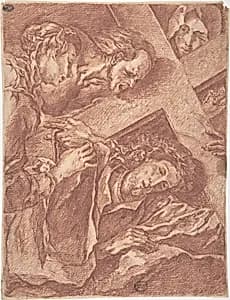
Christ Carrying the Cross
Medium
Red chalk
Dimensions
8 1/16 x 10 7/16 in. (20.4 x 26.5 cm)
Classification
Drawings
Department
Drawings and Prints
Museum
Metropolitan Museum of Art, New York, NY
Credit
Gift of Cornelius Vanderbilt, 1880
Accession Number
80.3.553
Rights
Public Domain
Tags
Art Historical Context
This delicate red chalk drawing, *Christ Carrying the Cross*,ails from 18th-century France and is attributed variably to the anonymous hand of a French artist or to Jean-Baptiste Greuze, a master of emotive Rococo and early Neoclassical styles. Measuring just over 8 by 10 inches, it captures a poignant moment from the Passion of Christ: Jesus burdened by the cross, surrounded by figures including men and women, their expressions conveying sorrow and devotion. Red chalk, or sanguine, was prized in the 18th century for its warm tones and ability to render soft modeling of flesh and fabric, making it ideal for preparatory studies or standalone devotional works. In the context of French art during the Enlightenment era, such intimate religious drawings reflected a shift toward personal piety amid growing secularism, blending dramatic narrative with subtle emotional depth. Greuze, if the artist, was renowned for infusing sentimentality into his subjects, elevating everyday pathos to the sacred. This piece exemplifies the era's drawing tradition, where chalk sketches served as both artistic exercises and aids for larger paintings or engravings. A treasured part of the Metropolitan Museum of Art's Drawings and Prints collection, it was generously gifted by Cornelius Vanderbilt in 1880, underscoring the Gilded Age passion for European masterpieces. Visitors will appreciate its intimate scale, inviting close contemplation of faith's human toll.
About the Artist
Anonymous, French, 18th century|Jean-Baptiste Greuze · 1700–1800
The artist known as Anonymous, French, 18th century, represents a collective of unidentified talents active roughly between 1700 and 1800, a period of profound artistic evolution in France from the opulent Rococo to the austere dawn of Neoclassicism and Revolutionary fervor. Little is documented about their personal training or mentors, as their anonymity obscures individual biographies, though th...