
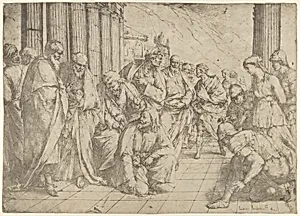
Christ kneels and writes on the pavement at center and a woman taken in adultery by three soldiers at right
1653
Medium
Etching
Dimensions
Sheet: 14 1/8 × 19 3/4 in. (35.9 × 50.2 cm)
Classification
Prints
Department
Drawings and Prints
Museum
Metropolitan Museum of Art, New York, NY
Credit
Bequest of Phyllis Massar, 2011
Accession Number
2012.136.912
Rights
Public Domain
Tags
Art Historical Context
In this striking 1653 etching by Luca Giordano, a young Neapolitan artist on the cusp of Baroque mastery, we witness a pivotal biblical moment from the Gospel of John (8:1-11). At the center, Christ kneels humbly, his finger tracing words on the pavement—traditionally interpreted as a challenge to the accusers: "Let he who is without sin cast first stone." To the right, three soldiers stand over a woman taken in adultery, their postures tense with judgment, embodying the drama of mercy triumphing over condemnation. Giordano's composition masterfully balances intimacy and tension, drawing viewers into the moral heart of the scene. Created when Giordano was just 19, this print showcases his early prowess in etching, a technique where acid bites into a copper plate to create rich, expressive lines. Etchings like this allowed artists to disseminate intricate designs widely, bridging painting and printmaking during the 17th century. Giordano's fluid, dynamic style foreshadows his later fresco triumphs, infusing religious narratives with emotional immediacy and theatrical light. Measuring 14 1/8 × 19 3/4 inches, this work from the Metropolitan Museum of Art's Drawings and Prints department (Bequest of Phyllis Massar, 2011) captures timeless themes of forgiveness and human frailty, inviting reflection on justice in an age of religious fervor.
About the Artist
Luca Giordano · 1634–1705
Luca Giordano (1634–1705) was an Italian painter of the late Baroque period who was one of the most prolific and versatile artists of the seventeenth century, earning the nickname "Luca fa presto" ("Luca works fast") for his extraordinary speed of execution. Born in Naples, he studied under José de Ribera and traveled extensively in Italy, absorbing influences from the Venetian colorists, Pietro d...