
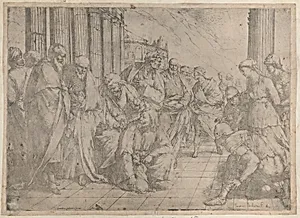
Christ kneels and writes on the pavement at center, while the woman taken in adultery stands between three soldiers at right
Medium
Etching; second state of two
Dimensions
Plate: 14 3/16 × 19 7/8 in. (36.1 × 50.5 cm) Sheet: 14 13/16 × 20 11/16 in. (37.6 × 52.5 cm)
Classification
Prints
Department
Drawings and Prints
Museum
Metropolitan Museum of Art, New York, NY
Credit
The Elisha Whittelsey Collection, The Elisha Whittelsey Fund, 1947
Accession Number
47.100.888
Rights
Public Domain
Art Historical Context
This etching captures a pivotal moment from the Gospel of John (8:1-11), where Christ kneels to write on the pavement, declaring, "Let him who is without sin among you be the first to throw a stone" at the woman accused of adultery. She stands nervously between three soldiers at right, heightening the drama of mercy triumphing over judgment. Created in 1653 by Neapolitan artist Luca Giordano, with etching by Francesco Palmieri, reflects the Baroque era's emphasis on emotional intensity and moral theater. As a second state of two impressions from a large plate (14 3/16 × 19 7/8 in.), this print showcases etching's precision—acid biting into metal to create rich, velvety lines that convey movement and texture. Giordano, then just 19, was already mastering dynamic compositions that would define his prolific career in frescoes and oils. Prints like this made grand religious narratives accessible, spreading Counter-Reformation ideals of redemption across Europe. Housed in the Metropolitan Museum of Art's Elisha Whittelsey Collection, it exemplifies 17th-century printmaking's role in democratizing art, inviting viewers to ponder timeless themes of forgiveness amid human frailty.
About the Artist
Luca Giordano|Francesco Palmieri · 1634–1705
Luca Giordano (1634–1705) was an Italian painter of the late Baroque period who was one of the most prolific and versatile artists of the seventeenth century, earning the nickname "Luca fa presto" ("Luca works fast") for his extraordinary speed of execution. Born in Naples, he studied under José de Ribera and traveled extensively in Italy, absorbing influences from the Venetian colorists, Pietro d...