
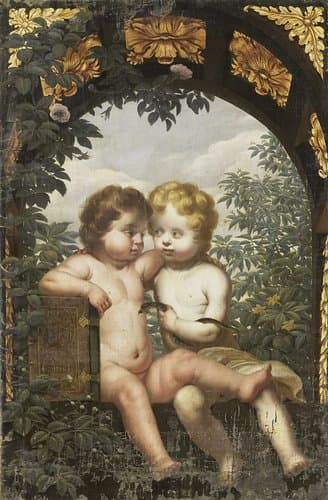
Christelijke allegorie met twee kinderen met een bijbel en een slang
1650 - 1699
Medium
oil on canvas
Dimensions
114; 9.8; 85.6; 123.1; 2.3; 75.5
Rights
Public Domain
About this artwork
height 114 cm x width 75.5 cm x thickness 2.3 cm
Art Historical Context
This enigmatic oil on canvas, titled *Christelijke allegorie met kinderen met een bijbel een slang* (Christian Allegory with Two Children Holding a Bible and a Snake dates to the late 17th century (1650–1699) and hails from an anonymous Dutch artist. Measuring 114 × 75.5 cm, it exemplifies the intimate scale typical of paintings meant for private homes or small chapels during the Dutch Golden Age. Oil on canvas was the era's premier medium, prized its ability to render luminous skin tones, intricate fabrics, and dramatic light effects that heighten emotional impact. The composition centers on a profound Christian allegory: two children embody innocence confronting moral duality. One clutches a Bible, symbolizing faith, purity, and divine guidance, while the other engages a serpent—the biblical emblem of temptation and original sin from the Garden of Eden. Such imagery was culturally vital in Protestant Netherlands, where art often served as didactic tools for households, reinforcing virtues amid religious fervor post-Reformation. Housed in the Rijksmuseum, this anonymous work reflects the period's blend of Baroque realism and symbolic depth, inviting viewers to ponder temptation's perils and salvation's promise. Though the artist's identity remains elusive, its survival underscores the enduring appeal of moral allegories in everyday devotion.
About the Artist
anonymous
In the vast tapestry of art history, "Anonymous" stands not as a singular individual but as a collective designation for countless unidentified creators whose works have endured across millennia. These artists, spanning prehistoric cave painters to medieval illuminators and folk craftsmen, produced the foundational layers of human visual culture. Prior to the Renaissance, when individual fame emer...