
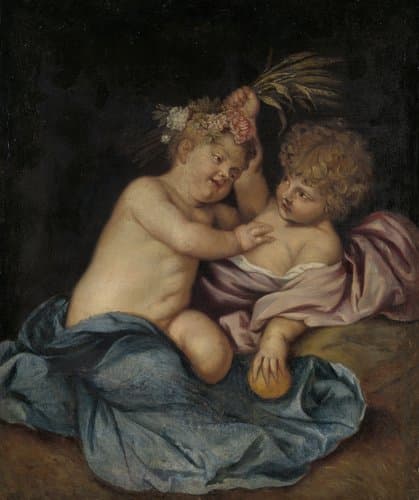
Two Infants, Personifications of Spring and Autumn
1650 - c. 1670
Medium
oil on canvas
Dimensions
47.6; 54.6; 45.7; 38.3; 9.8; 2.8
Rights
Public Domain
About this artwork
support: height 45.7 cm x width 38.3 cm x thickness 2.8 cm (support incl. backboard)
Art Historical Context
In the Rijksmuseum's collection, *Two Infants, Personifications Spring and Autumn* (c. 1650–1670) by Flemish Baroque artist Thomas Willeboirts Bosschaert the playful yet profound symbolism of the seasons through cherubic infants. Painted in oil on canvas—a medium favored in the Dutch Golden Age for luminous glazes and rich textures—this intimate work measures just 45.7 x 38.3 cm, it was designed for a private cabinet or study, where viewers could ponder its allegorical depth up close. Bosschaert, influenced by masters like Rubens and Van Dyck, specialized in history paintings and mythological scenes, blending realism with dramatic light and soft modeling. Here, the infants embody Spring's renewal and Autumn's abundance, a common Baroque motif reflecting the era's fascination with nature's cycles, vanitas themes, and the fleeting passage of time. Such personifications drew from classical antiquity, revived during the Renaissance, to remind 17th-century patrons of life's transience amid prosperity. This small-scale gem highlights Bosschaert's skill in rendering youthful innocence with tactile warmth, inviting museum visitors to appreciate how everyday symbols like seasons became vehicles for philosophical reflection in Flemish art.
About the Artist
Thomas Willeboirts Bosschaert · 1614–1654
Comment on works: History; Mythology