
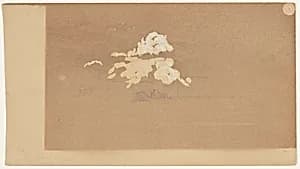
Clouds, Jamaica
May–September 1865
Classification
landscapes
Department
Smithsonian Collection
Museum
Smithsonian American Art Museum
Credit
Gift of Louis P. Church
Accession Number
1917-4-387-a
Rights
Public Domain
About this artwork
Research in Progress
Art Historical Context
Frederic Edwin Church, master of the Hudson River School painted *Clouds, Jamaica* a stay on the Caribbean island from May to September 1865 As one of America's foremost landscape artists (1826–1900), Church was renowned for his epic depictions of nature's sublime power, often drawing from personal travels to remote locales. work, classified as a, captures the dramatic skies over Jamaica, reflecting his fascination with atmospheric phenomena amid lush tropical settings—a departure from his more famous South American vistas like *Heart of the Andes*. Church's style emphasized luminism, a technique highlighting transient light effects and ethereal clouds to evoke awe and the divine in the natural world. Created in the turbulent post-Civil War era, the painting offered viewers a transcendent escape, underscoring nature's resilience and beauty. Though the medium remains unidentified amid ongoing research, its focus on Jamaica's skies showcases Church's meticulous observation of weather's grandeur. Today, *Clouds, Jamaica* graces the Smithsonian American Art Museum's Smithsonian Collection, a gift from Louis P. Church. It invites us to ponder how fleeting cloud formations can mirror the vastness of human experience, much like Church's own journeys for inspiration and healing.