
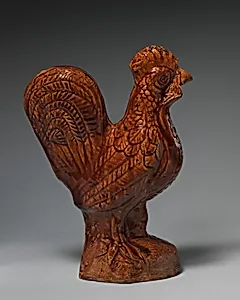
Cock
Unknown Artist
ca. 1790
Medium
Pottery, brown glaze
Dimensions
Height: 9 1/2 in. (24.1 cm)
Classification
Ceramics-Pottery
Culture
British, Staffordshire
Department
European Sculpture and Decorative Arts
Museum
Metropolitan Museum of Art, New York, NY
Credit
Rogers Fund, 1912
Accession Number
12.142.6
Rights
Public Domain
Tags
Art Historical Context
Step into the charming world of 18th-century British folk art with *Cock*, a delightful pottery figure from Staffordshire, dating to around 1790. Standing at 9½ inches tall, this unknown artist's creation captures a proud rooster in glazed earthenware, its rich brown glaze evoking the earthy tones of rural England. Crafted in the heart of Staffordshire's renowned pottery industry, this piece exemplifies the region's specialization in affordable, hand-modeled ceramics that brought whimsy and warmth to middle-class homes. Staffordshire potters were masters of press-molded figures, producing lively animal sculptures like this rooster—often perched on pedestals or pieced together from molds—for mantelpieces and shelves. The brown glaze, likely lead-based, provided a glossy, durable finish that highlighted the bird's bold form and feathered details, making it both decorative and subtly functional as a symbol of the countryside. These figurines reflected Britain's agrarian culture, where roosters embodied vigilance, prosperity, and the rhythms of farm life. Acquired through the Rogers Fund in 1912, *Cock* now graces the Metropolitan Museum of Art's European Sculpture and Decorative Arts collection. It invites us to appreciate the artistry in everyday objects, bridging fine art and humble hearthside charm.