
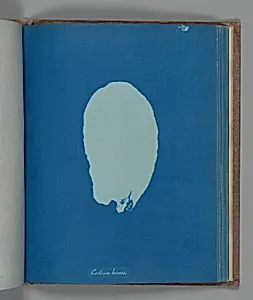
Codium bursa
ca. 1853
Medium
Cyanotype
Dimensions
Image: 25.3 x 20 cm (9 15/16 x 7 7/8 in.)
Classification
Photographs
Department
Photographs
Museum
Metropolitan Museum of Art, New York, NY
Credit
Gilman Collection, Purchase, The Horace W. Goldsmith Foundation Gift, through Joyce and Robert Menschel, 2005
Accession Number
2005.100.557 (120)
Rights
Public Domain
Art Historical Context
Anna Atkins's *Codium bursa* (ca. 1853) is a stunning cyanotype photogram capturing the delicate, branching form of this green alga, a marine plant native to British waters. Atkins, a British botanist and photographer born in 1799, was a trailblazing figure in the early days of photography. Working in the 1840s and 1850s, she produced *Photographs of British Al: Cyanotype Impressions the first book ever illustrated entirely with photographic images, predating similar scientific uses of the medium. The cyanotype process, invented by Sir John Herschel in 1842, involves placing objects directly on light-sensitive paper coated with ferric ammonium citrate and potassium ferricyanide, then exposing it to sunlight. This contact-printing technique yields the signature Prussian blue tones seen here, with *Codium bursa*'s fronds creating intricate white silhouettes against the vivid azure ground. Measuring just 25.3 x 20 cm, the intimate scale invites close inspection of nature's filigree patterns. Atkins's work bridged art and science, offering precise botanical records while revealing the poetic beauty of the natural world. Housed in the Metropolitan Museum of Art's Gilman Collection, this piece exemplifies how 19th-century innovation transformed scientific documentation into enduring visual poetry.
About the Artist
Anna Atkins · 1799–1871
Anna Atkins (née Children), born on March 16, 1799, in Tonbridge, Kent, England, grew up immersed in the world of science thanks to her father, John George Children, a prominent chemist, zoologist, and curator at the British Museum. After her mother Hester's death shortly after childbirth in 1800, Anna formed a close bond with her father, receiving an exceptional scientific education rare for wome...