
Coin of Kanishka
Unknown Artist
ca. 130
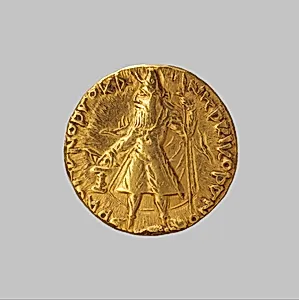
Medium
Gold
Dimensions
Diam. 9/16 in. (1.4 cm)
Classification
Metalwork
Culture
Pakistan (ancient region of Gandhara)
Department
Asian Art
Museum
Metropolitan Museum of Art, New York, NY
Credit
Bequest of Joseph H. Durkee, 1898
Accession Number
99.35.3024
Rights
Public Domain
Tags
Art Historical Context
This exquisite gold coin, struck around 130 CE during the reign of Kanish, the great Kushan emperor, hails from the ancient region of Gand in present-day Pakistan. Measuring just 9/16 inch (1.4 cm) in diameter, it exemplifies the artistry of Kushan metalwork, where numismatics served as both currency and royal propaganda. Kanishka who ruled a vast empire stretching from Central Asia to northern India, used such coins to proclaim his power and religious patronage, blending diverse cultural influences in a time of Silk Road exchange. Gandhara's unique Greco-Buddhist style shines through Kushan coinage, fusing Hellenistic realism—introduced by Alexander the Great—with Persian, Indian, and emerging Buddhist motifs. Though the artist remains unknown, the precision of gold striking techniques highlights advanced minting skills, ensuring fine details endured. These dinars, made from high-purity gold, symbolized economic prosperity and Kanishka's support for Buddhism, Zoroastrianism, and Greek deities, reflecting his tolerant cosmopolitan court. Today, this coin from the Metropolitan Museum of Art's Asian Art collection, bequeathed by Joseph H. Durkee in 1898, offers a tangible portal to an empire that bridged East and West, inviting us to ponder the interconnected world of antiquity.