
Constantinus Lebra mundatus p un dies latuit cum B. Silvestro a quo baptiz (...)
1645 - 1700
Medium
etching
Dimensions
101; 101; 177; 176
Rights
Public Domain
About this artwork
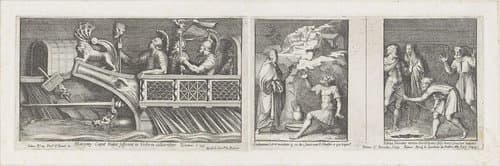
Blad met twee prenten. Links: vier soldaten op een boot. Rechts: twee voorstellingen. Paus Silvester geneest Keizer Constantijn van lepra en de heilige Helena vindt het ware kruis. Titels in de ondermarge.
Art Historical Context
Pietro Santi Bartoli's etching *Constantinus Lebra mund p un dies latuit B. Silvestro a quo baptiz (...)*, created between 1645 and 1700, captures pivotal moments from early Christian legend in a compact 101 × 177 mm sheet. This Baroque-era print features three scenes: on the left, four soldiers a boat; on the, Pope Sylvester I healing Emperor Constantine of leprosy, and Saint Helena the True Cross. Titles inscribed in the lower margin guide viewers through these devotional narratives, blending history and hagiography. The subjects draw from medieval legends central to Christian iconography. Constantine's miraculous cure by Sylvester—leading to his baptism and support for the Church—symbolized the empire's embrace of Christianity, while Helena's quest for the True Cross underscored relics' sacred power. Bartoli, a Roman engraver known for precise reproductive prints, rendered these in etching, a technique prized for its fluid lines and tonal depth, ideal for disseminating religious stories to a wider audience beyond grand paintings. As a small-scale work, this etching reflects 17th-century Italy's vibrant print culture, making elite Baroque imagery accessible for private devotion or study. Its intricate composition invites close contemplation, revealing Bartoli's skill in evoking drama and faith within modest dimensions.
About the Artist
Pietro Sante Bartoli · 1615–1700
Pietro Santi Bartoli, born in Perugia in 1635, emerged as a pivotal figure in the Roman antiquarian revival of the late seventeenth century. Relocating to Rome as a youth, he initially pursued painting, studying under the French artist Jean Lemaire—known as "Le Petit Lemaire"—and later under the esteemed Nicolas Poussin, whose classical rigor profoundly shaped his early approach. Though traces of ...