
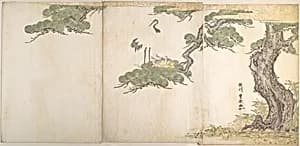
Crane and Their Young in Their Nest in the Branches of a Pine-tree
ca. 1790
Medium
Triptych of woodblock prints (surimono enriched with gold); ink and color on paper
Dimensions
Aiban; H. 13 7/8 in. (35.2 cm); W. 9 7/8 in. (25.1 cm)
Classification
Prints
Culture & Period
Japan · Edo period (1615–1868)
Department
Asian Art
Museum
Metropolitan Museum of Art, New York, NY
Credit
Fletcher Fund, 1929
Accession Number
JP1566
Rights
Public Domain
Tags
Art Historical Context
In the serene branches of an ancient pine tree, Utagawa Toyoharu's *Crane and Their Young in Their Nest* (ca. 1790) captures a tender family moment from Japan's Edo period (1615–1868). Toyoharu, a pioneering artist and founder of the influential Utagawa school, this triptych as a luxurious *surimono*—a privately commissioned woodblock print often exchanged as a New Year's greeting among elites. Printed in vibrant ink and color on paper, with delicate gold embellishments, the aiban-sized panels (each about 13 7/8 x 9 7/8 in.) showcase the precision of ukiyo-e techniques, where carvers and printers layered colors and metallic flecks for a shimmering, almost three-dimensional effect. Cranes, revered in Japanese culture as symbols of longevity and fidelity, nestle protectively amid the pine tree's twisting boughs—another emblem of eternal life and resilience. This harmonious scene reflects Edo-era fascination with nature's poetry, blending realism with symbolic depth to evoke wishes for prosperity and family harmony. Toyoharu's mastery of composition unites the triptych into a panoramic vista, inviting viewers to ponder the enduring beauty of the natural world. Housed in the Metropolitan Museum of Art's Asian Art Department (Fletcher Fund, 1929), this print exemplifies *surimono*'s role as an intimate art form, bridging fine art and personal expression in a time when woodblock printing democratized beauty for discerning patrons.
About the Artist
Utagawa Toyoharu · 1735–1814
Utagawa Toyoharu (1735–1814) holds a foundational place in the history of Japanese printmaking as the founder of the prolific and long-lived Utagawa school, which would go on to produce some of the most celebrated names in ukiyo-e, including Hiroshige and Kuniyoshi. Born in what is now Hyogo Prefecture, Toyoharu moved to Edo, where he studied under Toriyama Sekien and later explored the Kano schoo...