
Eight Views of the Xiao and Xiang Rivers
Late 17th–early 18th century
Medium
Pair of six-fold screens; ink, colors, and gold paint on paper
Dimensions
170 × 390 cm (66 15/16 × 153 9/16 in.)
Classification
screen
Department
Arts of Asia
Museum
Art Institute of Chicago
Accession Number
29757
Rights
Public Domain
Art Historical Context
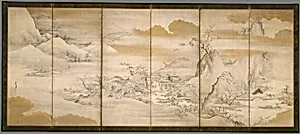
**Eight Views of the Xiao and Xiang Rivers** by Sekkei, from the late 17th early 18th century, captivates with its poetic portrayal of misty landscapes along China's legendary Xiao and Xiang rivers. This of six-fold screens, an impressive 170 × 390 cm, unfolds like a panoramic scroll, inviting viewers to immerse themselves in eight iconic scenes—a theme rooted in Song dynasty Chinese literati painting. Adopted in Japan during the Edo period it evokes themes of longing, solitude, and natural beauty, blending Chinese poetic tradition with Japanese sensibility. Crafted in ink, colors, and gold paint on paper, the screens showcase masterful techniques typical of Japanese byōbu (folding screens). Delicate ink washes suggest atmospheric depth, while subtle colors and shimmering gold grounds create a luminous, ethereal glow, enhancing the dreamlike quality of fog-shrouded mountains and serene waters. Gold paint, a hallmark of opulent Japanese decorative arts, transforms the screens into luxurious room dividers for elite homes or temples. Housed in the Art Institute of Chicago's Arts of Asia department, this work highlights the cross-cultural exchange between China and Japan, where artists like Sekkei reinterpreted classical motifs with fresh elegance. A testament to Edo-period refinement, it reminds us how screens blurred art and architecture, turning everyday spaces into contemplative retreats.