
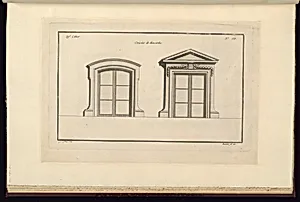
Croisées de Mansardes
Classification
Department
Smithsonian Collection
Museum
Smithsonian American Art Museum
Credit
Purchased for the Museum by the Advisory Council
Accession Number
1921-6-254-38
Rights
Public Domain
About this artwork
Research in Progress
Art Historical Context
**Croisées de Mans** is a captivating print created around 1775 by Juste Boucher (1736–1782), a French artist and engraver known for his intricate designs in the waning years of the Rococo era. As the nephew of the famed painter François Boucher,e-François carried forward the family's legacy of elegant ornamentation, blending fluid lines emerging neoclassical precision. The title, translating roughly to "Crossings ofard Roofs," evokes the distinctive steep, curved roofs popularized in French architecture during the 17th and 18th centuries, suggesting this work captures intersecting attic structures or decorative motifs inspired by urban Parisian rooftops. Printed works like this one were vital in the 18th century for sharing architectural ideas and ornamental patterns among artisans, architects, and collectors across Europe. Boucher's technique likely employed fine engraving, allowing for detailed renderings that could be reproduced and studied widely. Acquired by the Smithsonian American Art Museum through its Advisory Council, this piece bridges French decorative arts with American collections, highlighting transatlantic exchanges in taste and design just before the French Revolution. Though research continues, *Croisées de Mansardes* invites us to appreciate the artistry of everyday architecture, frozen in delicate lines that whisper of opulent 18th-century Paris. (198 words)