
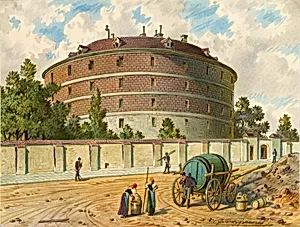
Das alte Irrenhaus in Wien (Narrenturm), "Kaiser Joseph-Gugelhupf" genannt
undatiert
Medium
Aquarell auf Papier
Dimensions
16,2 x 21,2 cm
Classification
Zeichnung
Department
Belvedere Collection
Museum
Belvedere
Credit
Belvedere, Vienna
Accession Number
4664/14
Rights
Public Domain
Art Historical Context
In the Belvedere Collection in Vienna, Franz Geras's undated watercolor *Das alte Irrenhaus Wien (Narrenturm "Kaiser Joseph-Gugelhupf" genannt* captures a quirky slice of Enlightenment-era architecture. This delicate aquarell on paper, measuring just 16.2 x 21.2 cm, depicts theenturm, Vienna's former insane asylum built in 1784 under Emperor Joseph II. Nicknamed "Kaiser Joseph-Gugelhupf" for its bundt-cake-like shape with rounded towers, the structure was one of Europe's first dedicated facilities for the mentally ill, reflecting reforms aimed at humane treatment rather than punishment. Gerasch, an Austrian artist active in the Biedermeier period (1780–1861), excelled in precise architectural and landscape views, often using watercolor's translucent qualities to evoke light and texture on stone facades. His intimate drawing highlights the building's eccentric design—circular with radial wards—now a preserved monument symbolizing the shift from medieval superstition to modern psychiatry. Today, the Narrenturm houses the Pathological-Anatomical Collection, adding layers to its haunting legacy. This small-scale work invites visitors to ponder Vienna's layered history: imperial ambition, medical progress, and architectural whimsy, all rendered with Gerasch's meticulous touch.