
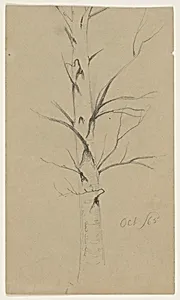
Dead Tree, Vermont
October 1865
Classification
drawing
Department
Smithsonian Collection
Museum
Smithsonian American Art Museum
Credit
Gift of Louis P. Church
Accession Number
1917-4-433-a
Rights
Public Domain
About this artwork
Research in Progress
Art Historical Context
**Dead Tree, Vermont** *Frederic Edwin Church (American, 18261900), October 1865* *Drawing; Smithsonian American Art Museum, Gift of Louis P.* Frederic Edwin Church, master of the Hudson River School, immortalized the raw beauty and drama of American nature in this evocative drawing from October 1865. As one of the movement's luminaries, Church celebrated the sublime wilderness, often drawing from direct observation during his travels. Created just months after the Civil War's end, *Dead Tree, Vermont* reflects a moment when artists turned to the enduring landscapes of New England for solace and national renewal, capturing Vermont's rugged autumnal terrain. The stark silhouette of the dead tree stands as a poignant symbol—perhaps evoking nature's cycles of decay and regeneration, themes resonant in 19th-century Romanticism. Though the exact medium remains under study, as a drawing it likely served as a preparatory sketch for Church's grand oil paintings, showcasing his meticulous eye for light, texture, and atmospheric detail. Housed in the Smithsonian American Art Museum through a family gift from Louis P. Church, this work offers a intimate glimpse into the artist's process. Visitors will appreciate how such studies fueled Church's epic canvases, like *Niagara* or *Heart of the Andes*, bridging personal observation with America's manifest destiny in art. Research continues to uncover more about this quiet yet powerful piece.