
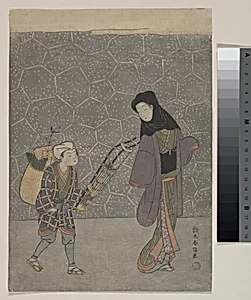
Demon-crushing Bow
ca. 1765
Medium
Woodblock print; ink and color on paper
Dimensions
H. 11 5/8 in. (29.5 cm); W. 8 3/8 in. (21.3 cm)
Classification
Prints
Culture & Period
Japan · Edo period (1615–1868)
Department
Asian Art
Museum
Metropolitan Museum of Art, New York, NY
Credit
Rogers Fund, 1922
Accession Number
JP1010
Rights
Public Domain
Tags
Art Historical Context
Suzuki Harunobu *Demon-crushing Bow* (ca. 1765) is a delightful woodblock print from Japan's Edo period (16151868), capturing the playful spirit of ukiyo-e, the "floating world" genre that celebrated everyday life, beauty, and whimsy. ink and color print on paper, measuring about 11⅝ × 8⅜ inches, likely depicts boys and women engaged with a bow and arrow—evoking lighthearted scene of childhood games or folklore where the bow "crushes demons," blending innocence with protective mythology. Harunobu, a pioneering ukiyo-e artist, revolutionized printmaking around 1765 by introducing full-color *nishiki-e* (brocade pictures), layering delicate hues through intricate woodblock carving and precise registration. His works often featured *bijin-ga* (pictures of beautiful women) and charming child subjects, reflecting urban Edo's vibrant culture amid the Tokugawa shogunate's prosperity. Housed in the Metropolitan Museum of Art's Asian Art Department (Rogers Fund, 1922), this print exemplifies how woodblocks enabled affordable art for the masses, spreading tales of valor and joy. Its compact size suited personal collections, inviting viewers into a world where even demons fall to youthful daring.
About the Artist
Suzuki Harunobu · 1725–1770
Suzuki Harunobu (c. 1725-1770) was a Japanese ukiyo-e artist who revolutionized woodblock printing by developing nishiki-e—full-color prints using multiple woodblocks—in 1765. Before Harunobu, Japanese prints were limited to two or three colors; his innovation unleashed the entire artist's palette, transforming ukiyo-e into the vibrant art form that would later captivate Western artists from Manet...