
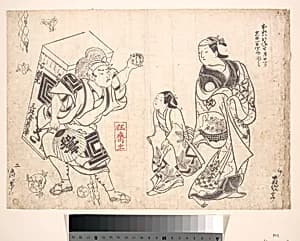
The Mogusa-uri Scene from the Drama "Chujo-hime Hibariyama," Performed at Yamamura-za
1710–13
Medium
Woodblock print; ink and color on paper
Dimensions
10 3/8 x 14 3/4 in. (26.4 x 37.5 cm)
Classification
Prints
Culture & Period
Japan · Edo period (1615–1868)
Department
Asian Art
Museum
Metropolitan Museum of Art, New York, NY
Credit
Rogers Fund, 1918
Accession Number
JP542
Rights
Public Domain
Tags
Art Historical Context
Step into the lively world of Edo-period kabuki theater with Okumura Masanobu's woodblock print, *The Mogusa-uri Scene from the Drama "Chujo-hime Hibariyama," Performed at Yamamura-za* (ca. 1710–13). This ink-and-color print on paper, measuring 10 3/8 x 14 3/4 inches, captures actors mid-performance in a dramatic moment from the popular play staged at Tokyo's Yamamura-za theater. Masanobu, a trailblazing ukiyo-e ("pictures of the floating world") artist, specialized in yakusha-e—prints glorifying kabuki stars—bringing the theater's glamour to everyday viewers. During Japan's Edo period (1615–1868), urban culture thrived amid economic prosperity, and kabuki became a spectacle of elaborate costumes, poses, and storytelling. Masanobu's innovative techniques, including early multi-block color printing, added vivid pinks, blues, and blacks to heighten the actors' expressive faces and flowing robes, making high art affordable through mass production. Today, in the Metropolitan Museum of Art's Asian Art collection (Rogers Fund, 1918), this print reveals how ukiyo-e democratized celebrity culture, preserving fleeting performances for posterity and influencing global printmaking traditions.
About the Artist
Okumura Masanobu · 1686–1764
Japanese, 1686–1764