
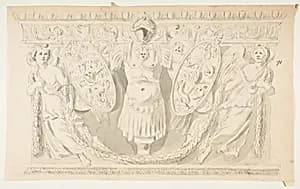
Design after a Roman Frieze
18th century
Medium
Pen and gray ink with brush and gray wash over graphite on laid paper
Dimensions
sheet: 8 3/4 x 14 3/8 in. (22.2 x 36.5 cm)
Classification
Drawings
Department
Drawings and Prints
Museum
Metropolitan Museum of Art, New York, NY
Credit
Gift of Regina Slatkin, 1963
Accession Number
63.712.71
Rights
Public Domain
Tags
Art Historical Context
This delicate 18th-century drawing, titled *Design after a Roman Frieze captures the enduring fascination of French artists with classical antiquity. Created anonymously by a French draftsman, it reinterprets motifs from an ancient Roman frieze, featuring dynamic figures of women adorned with shields and armor—evoking warrior goddesses or Amazon-like heroines. During the Enlightenment era, such copies served as vital studies for architects, sculptors, and decorators, fueling the neoclassical revival that swept Europe and influenced grand projects like those at Versailles. Executed in pen and gray ink with brush and gray wash over graphite on laid paper, the work showcases meticulous technique. The graphite underdrawing provides a precise foundation, while the ink lines and subtle washes build depth and shadow, mimicking the sculptural relief of stone friezes. This layered approach highlights the artist's skill in translating three-dimensional antiquity into two-dimensional elegance, a common practice in academic ateliers. Housed in the Metropolitan Museum of Art's Drawings and Prints department (gift of Regina Slatkin, 1963), this 8 3/4 x 14 3/8-inch sheet exemplifies how 18th-century Europeans bridged past and present, preserving Roman grandeur for modern inspiration. Visitors will appreciate its whisper of ancient valor in a whisper-thin medium.
About the Artist
Anonymous, French, 18th century · 1700–1800
The artist known as Anonymous, French, 18th century, represents a collective of unidentified talents active roughly between 1700 and 1800, a period of profound artistic evolution in France from the opulent Rococo to the austere dawn of Neoclassicism and Revolutionary fervor. Little is documented about their personal training or mentors, as their anonymity obscures individual biographies, though th...