
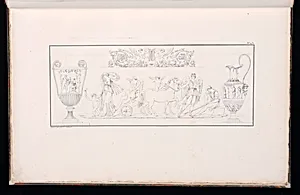
Ornament and Vase Designs
Classification
Department
Smithsonian Collection
Museum
Smithsonian American Art Museum
Credit
Purchased for the Museum by the Advisory Council
Accession Number
1921-6-372-8
Rights
Public Domain
About this artwork
Research in Progress
Art Historical Context
**Ornament and Vase** by Charles Normand, prominent French engraver (1765–1840), dates to the late 1780s through 1795, a pivotal era bridging the Ancien Régime and the Revolution. This print, now in the Smithsonian American Art's collection (purchased by the Advisory Council), showcases Normand's expertise in ornamental design, likely featuring intricate motifs for vases and decorative elements. As a print, it exemplifies the era's reproductive techniques—such as etching or engraving—that allowed elegant patterns to be widely shared among artisans, architects, and collectors. Normand worked in the neoclassical style, drawing inspiration from ancient Greek and Roman forms revived during the Enlightenment. His designs reflect the period's fascination with symmetry, classical motifs like acanthus leaves and urns, and refined proportions, which influenced furniture, ceramics, and interior decoration across Europe. These patterns were practical tools for workshops, promoting standardized beauty in luxury goods amid France's thriving decorative arts scene. Though research on this specific work continues, its presence in an American museum highlights the transatlantic exchange of design ideas in the early republic era, when U.S. tastemakers imported European elegance to furnish their new nation. Visitors can appreciate how such prints bridged art and craft, embodying the timeless allure of neoclassical ornamentation.