
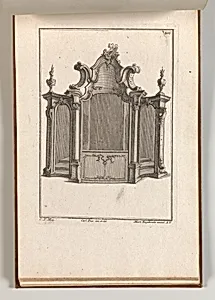
Design for a Confessional, Plate 4 from an Untitled Series of Designs for Confessionals
Printed ca. 1750–56
Medium
Etching
Dimensions
Overall: 8 7/16 × 13 3/4 in. (21.5 × 35 cm)
Classification
Prints|Ornament & Architecture|Albums
Department
Drawings and Prints
Museum
Metropolitan Museum of Art, New York, NY
Credit
Purchase, Daniel Ergmann Gift, 2014
Accession Number
2014.97.88
Rights
Public Domain
Tags
Art Historical Context
This etching, titled *Design for a Confessional Plate 4* from untitled series, was printed around 1750–56 by Martin Engelbrecht and Pier. Hailing from the vibrant printmaking tradition of 18th-century Augsburg, Germany, it exemplifies the era's fascination with elaborate ecclesiastical architecture. Measuring 8 7/16 × 13 3/4 inches, the plate captures a ornate confessional booth—a key fixture in Catholic churches for the sacrament of penance—rendered in intricate detail through the precise lines of etching, a technique where acid etches designs into a metal plate for richly textured prints. Engelbrecht, a prolific engraver known for ornamental designs, and collaborator Carl Pier showcase the transitional Rococo style here, blending Baroque grandeur with lighter, asymmetrical flourishes. Confessionals like this one were central to Counter-Reformation churches, symbolizing privacy and spiritual intimacy amid opulent interiors. This print likely served as a pattern book for woodworkers and architects, disseminating fashionable motifs across Europe. Today, housed in the Metropolitan Museum of Art's Drawings and Prints department (purchased with the Daniel Ergmann Gift in 2014), it offers a window into how art and faith intertwined in the Enlightenment age, highlighting the craftsmanship that adorned sacred spaces.