
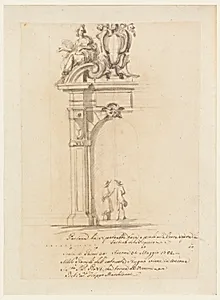
Design for a gate, for the reception of Pope Pius VI returning from Germany, in Ancona
Classification
architecture
Department
Smithsonian Collection
Museum
Smithsonian American Art Museum
Credit
Museum purchase through gift of various donors
Accession Number
1901-39-2183
Rights
Public Domain
About this artwork
Research in Progress
Art Historical Context
Filippo Marchionni’s “Design for a gate, for the reception of Pope Pius VI returning from Germany, in Ancona” captures a moment of civic and religious celebration in May 1782. Created as an architectural proposal, the work envisions a temporary or commemorative gateway intended to welcome the pontiff back to Italian soil after his travels. Such structures were common in the eighteenth century, serving both practical and symbolic roles during papal processions by transforming ordinary streets into stages for grandeur and devotion. Marchionni, an Italian architect and designer active during the late Baroque and early Neoclassical periods, brought elegance and proportion to the concept. Although the exact medium remains unknown, the drawing reflects the careful planning that went into ephemeral architecture—ornate yet functional designs meant to impress for a single occasion. Its presence in the Smithsonian American Art Museum’s collection highlights how European architectural ideas traveled and were preserved for study. This piece offers a glimpse into the intersection of faith, politics, and art in papal Italy, reminding viewers that even a gate could embody welcome, power, and artistic ambition.