
Design for a Knife Handle with a Scene of Christ Joining a Man and Woman
1580–1600
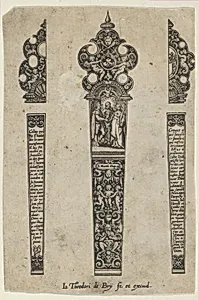
Medium
Engraving and blackwork
Dimensions
Sheet: 4 × 2 5/8 in. (10.2 × 6.7 cm)
Classification
Prints|Ornament & Architecture
Department
Drawings and Prints
Museum
Metropolitan Museum of Art, New York, NY
Credit
The Elisha Whittelsey Collection, The Elisha Whittelsey Fund, 1951
Accession Number
51.501.5784(3)
Rights
Public Domain
Tags
Art Historical Context
In the late 16th century, Johann Theodor de Bry, a skilled engraver from the prominent de Bry family of Flemish artists, created this intricate *Design for a Knife Handle with a Scene of Christ Joining a Man and Woman* around 1580–1600. The tiny sheet, measuring just 4 × 2⅝ inches, captures a tender religious moment: Christ blessing a bride and groom, surrounded by angels, symbolizing the sacred union of marriage. Such motifs drew from Christian iconography popular in Northern Renaissance art, blending spirituality with everyday objects. Rendered in engraving and blackwork—a technique using dense cross-hatching to achieve rich, velvety blacks—the print exemplifies the precision of intaglio printing. These ornamental designs were essential tools for goldsmiths and silversmiths, providing scalable patterns for luxury items like knife handles. De Bry's fine lines and shading allowed craftsmen to translate the scene onto metal with remarkable detail, reflecting the era's fusion of art, craft, and devotion. Housed in the Metropolitan Museum of Art's Drawings and Prints department, this work highlights the de Bry workshop's influence on decorative arts during the Mannerist period. It offers a glimpse into Renaissance workshops, where prints bridged fine art and functional design, making pious imagery accessible in personal possessions. Visitors will appreciate its delicate scale and the way it elevates a humble utensil into a spiritual treasure.
About the Artist
Johann Theodor de Bry · 1561–1923
Comment on works: copper engraver