
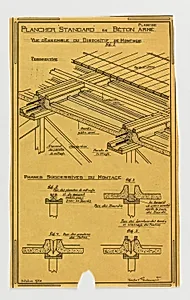
Design for a Mass-Operational House Designed by Hector Guimard, Construction Directions for the Supports
October 1920
Classification
architecture
Department
Smithsonian Collection
Museum
Smithsonian American Art Museum
Credit
Gift of Madame Hector Guimard
Accession Number
1956-78-1-33
Rights
Public Domain
About this artwork
Research in Progress
Art Historical Context
Hector Guimard, the celebrated French architect (1867–1942) best known for his sinuous Art Nouveau designs like the iconic Paris Métro, created this *Design for a Mass- House* in October 1920 Classified as architecture and housed in the Smithsonian American Art's Smithsonian Collection, this represents a practical blueprint—specifically, construction directions for the building's supports. Donated by Madame Hector Guimard, it offers a rare glimpse into Guimard's post-World War I innovations, as Europe grappled with housing shortages and the rise of efficient, scalable building methods. While Guimard's early career defined Art Nouveau's organic forms and wrought-iron flourishes, this 1920 design hints at his adaptation to modernist ideals of mass production and functionality. The title suggests a forward-thinking "mass-operational" house, possibly prefabricated or modular, aligning with emerging trends in affordable architecture amid rapid urbanization. Though the medium remains unknown and research is ongoing, such technical drawings were vital tools for engineers and builders, bridging artistic vision with real-world construction. This piece underscores Guimard's versatility, evolving from ornate public works to pragmatic residential solutions. A gift from his widow, it preserves his legacy in American collections, inviting us to ponder how one of Art Nouveau's masters anticipated the functionalist architecture of the 20th century.