
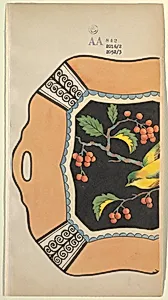
Design for a Platter
Classification
tableware designs
Department
Smithsonian Collection
Museum
Smithsonian American Art Museum
Credit
Smithsonian American Art Museum
Accession Number
1985-14-26
Rights
Public Domain
About this artwork
Research in Progress
Art Historical Context
**Design for a Platter** *Noritake, Japan and New York, New York, USA, 1880–1910* Smithsonian American Art Museum This elegant design for a platter hails from Noritake, the pioneering Japanese ceramics company that bridged Eastern craftsmanship and Western tastes during Japan's Meiji era (1868–1912). Active from the late 19th century, Noritake established a foothold in New York, exporting finely crafted tableware to American markets amid a surge in global demand for exotic yet functional porcelain. Dated between 1880 and 1910, this piece captures a pivotal moment when Japan modernized its artistry to appeal to international consumers, blending traditional motifs with practical designs for everyday dining. As a tableware design in the Smithsonian American Art Museum's collection, it exemplifies the fusion of utility and beauty that defined Noritake's legacy. Though research is ongoing and the medium remains unspecified—likely a preparatory drawing or pattern sketch—it reflects techniques honed in Nagoya kilns, where intricate glazes and shapes anticipated Art Nouveau influences. Culturally, such designs fueled America's fascination with Japonisme, transforming simple platters into symbols of refined hospitality and cross-cultural exchange. (178 words)