
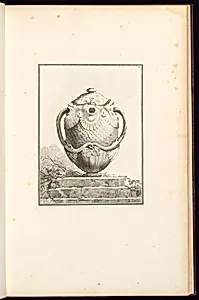
Design for a Vase
Medium
Classification
Department
Smithsonian Collection
Museum
Smithsonian American Art Museum
Credit
Purchased for the Museum by the Advisory Council
Accession Number
1921-6-471-25
Rights
Public Domain
About this artwork
Research in Progress
Art Historical Context
Ennemond Alexandre Petitot's *Design for a Vase (1764) is a delicate print that captures the elegance of mid-18th-century French decorative. Born in 1727, Petitot a prolific French architect, engraver, and designer whose works bridged the ornate Rococo style of Louis XV's reign with emerging Neoclassical restraint. Created during a golden age for luxury goods in Paris, this piece likely served as a prototype for porcelain, silver, or glass vases destined for aristocratic homes or royal courts. As a print medium, the artwork exemplifies how engraving democratized high design, allowing artisans across Europe to replicate intricate motifs like scrolling foliage, urn shapes, and symmetrical compositions. Petitot's precise lines highlight the technical mastery of the intaglio process, where metal plates were etched and inked to produce fine details transferable to three-dimensional objects. Housed in the Smithsonian American Art Museum's Print Department—acquired through the Advisory Council's purchase—this rare survival underscores transatlantic exchanges in artistic taste. Though research continues, *Design for a Vase* invites us to appreciate the blueprint of opulence, where paper became the spark for enduring beauty in Europe's grand salons. (198 words)