
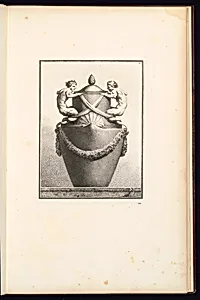
Design for a Vase
Classification
Department
Smithsonian Collection
Museum
Smithsonian American Art Museum
Credit
Purchased for the Museum by the Advisory Council
Accession Number
1921-6-471-32
Rights
Public Domain
About this artwork
Research in Progress
Art Historical Context
Ennemond Alexandre Petitot (1727–1801), a distinguished French architect and designer, created this *Design for a Vase* in 1764, a pivotal moment in 18th-century decorative arts. Working in Paris during the lavish era of Louis XV, Petitot bridged the ornate Rococo style with emerging Neoclassical restraint. His intricate designs for vases, furniture, and interiors influenced workshops across Europe, blending floral motifs, graceful curves, and classical symmetry. Classified as a print in the Smithsonian American Art Museum's collection—purchased by the Advisory Council—this work exemplifies how printed designs democratized high-style decoration. Prints like this served as blueprints for porcelain makers, silversmiths, and cabinetmakers, ensuring uniformity in luxury goods from Sèvres factories to royal commissions. Though the exact medium remains under study, such engravings were vital tools for disseminating innovative forms amid the Enlightenment's taste for elegance and reason. Petitot's later career took him to Poland, where he adorned King Stanisław August's palaces, but this 1764 vase design captures the sophisticated whimsy of pre-Revolutionary France. Imagine artisans poring over it to craft opulent tableware— a testament to design's power to shape everyday luxury. (198 words)