
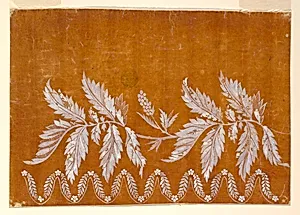
Design for an Embroidered or Woven Horizontal Border of the "Fabrique de St. Ruf"
1805–1815
Classification
Drawing
Department
Smithsonian Collection
Museum
Smithsonian American Art Museum
Credit
Gift of Eleanor and Sarah Hewitt
Accession Number
1914-21-95
Rights
Public Domain
About this artwork
Research in Progress
Art Historical Context
This delicate drawing, titled *Design for an Embro or Woven Horizontal Border the "Fabrique de. Ruf"*, hails from the renowned textile hub of Lyon, France, created between 1805 and 1815 by the Fabrique Saint Ruf workshop. Lyon was the epicenter of Europe's silk industry during the Napoleonic era, where innovative Jacquard looms—patented just a few years earlier in 1801—enabled intricate woven patterns that mimicked hand embroidery. As a preparatory design, this work would have guided artisans in producing luxurious borders for shawls, dresses, or furnishings, blending functionality with opulent Neoclassical motifs typical of the Empire style. Though the exact medium remains unidentified, such drawings were essential blueprints in Lyon's competitive textile trade, capturing repeating patterns that could be scaled for mass production. They highlight the fusion of artistry and industry, where skilled draftsmen translated fashion trends into reproducible elegance. Donated to the Smithsonian American Art Museum by collectors Eleanor and Sarah Hewitt, this piece reflects the global exchange of decorative arts that enriched American collections. Currently under research, it invites us to appreciate the unsung role of design workshops in shaping 19th-century luxury textiles, bridging French craftsmanship with enduring cultural legacy.