
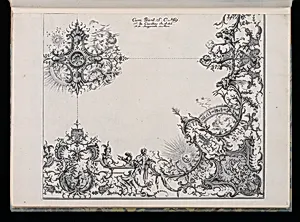
Design for Ceiling Ornament
Classification
Bound print
Department
Smithsonian Collection
Museum
Smithsonian American Art Museum
Credit
Purchased for the Museum by the Advisory Council
Accession Number
1921-6-282-11
Rights
Public Domain
About this artwork
Research in Progress
Art Historical Context
François de Cuvilli the Elder (1695–1768), a Belgian-born architect and designer who thrived at the Bavarian court in Munich, created this *Design for Ceiling Ornament around 1740. Trained in Paris and elevated from humble origins to a key figure in European decorative arts, Cuvilliés bridged French influences with German opulence. Active during the height of the Rococo era, he specialized in lavish interior schemes for palaces like Nymphenburg, where intricate ceiling decorations symbolized aristocratic splendor and playful elegance. As a bound print—likely from one of Cuvilliés's influential pattern books—this work exemplifies Rococo's exuberant style: swirling motifs, asymmetrical flourishes, and delicate shell-like forms intended to adorn grand spaces. These designs were not mere sketches but blueprints for artisans, disseminating sophisticated ornamentation across Europe and influencing cabinetmakers, stuccoists, and painters. The medium's portability made high-style decoration accessible beyond royal commissions. Housed in the Smithsonian American Art Museum, this piece highlights the transatlantic exchange of artistic ideas, bridging Old World Rococo with emerging American tastes. Though research continues, it invites us to imagine ceilings alive with movement and light, a testament to 18th-century dreams of refined luxury.