
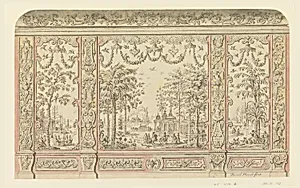
Design for Chinoiserie Wall Decoration
Classification
architecture, interiors
Department
Smithsonian Collection
Museum
Smithsonian American Art Museum
Credit
Purchased for the Museum by the Advisory Council
Accession Number
1911-28-213
Rights
Public Domain
About this artwork
Research in Progress
Art Historical Context
Daniel Marot's *Design for Chinoie Wall Decoration* (ca. 1720) captures the exuberant fusion of European and Asian aesthetics that defined early 18th-century interiors. A French Huguenot architect designer (1661–1752), Marot fled religious persecution to work in the Netherlands and England serving luminaries like William III and Queen Mary. His intricate drawings, classified here as architecture and interiors from the Smithsonian American Art Museum's collection, showcase his mastery of Baroque opulence, blending lavish ornamentation with functional elegance. Chinoiserie, the fanciful European interpretation of Chinese motifs—pagodas, exotic birds, and flowing lattices—reached a height of popularity around this time, symbolizing luxury and cosmopolitan taste among the elite. Marot's design likely envisioned paneled walls alive with these whimsical elements, reflecting the era's fascination with global trade and the exotic East via the burgeoning porcelain and silk imports. Though the medium remains unidentified amid ongoing research, such preparatory sketches were vital tools for workshops, guiding gilders and painters in creating immersive rococo spaces. This piece highlights Marot's enduring influence on decorative arts, bridging French grandeur with Anglo-Dutch refinement. Acquired through the museum's Advisory Council, it invites us to imagine stepping into a grand salon where fantasy met reality, a testament to the creativity sparked by cultural exchange.