
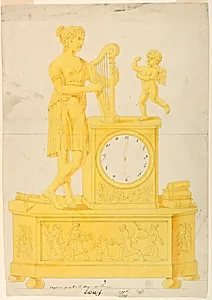
Design for Clock
1800–1825
Classification
timepieces & measuring devices
Department
Smithsonian Collection
Museum
Smithsonian American Art Museum
Credit
Gift of Eleanor and Sarah Hewitt
Accession Number
1931-71-22
Rights
Public Domain
About this artwork
Research in Progress
Art Historical Context
**Design for Clock, Lefebvre Manufactory, Tourn (1800–1825)** This *Design for Clock* from the Lefebvre Manufactory in Tournai Belgium, dates to the early 19th century, a time when decorative arts blended functionality with lavish ornamentation. Produced between 1800 and 1825, it captures the neoclassical elegance of the Napoleonic era, when clockmakers and designers elevated timepieces into luxurious status symbols for Europe's elite homes. Tournai's manufactories, renowned for fine porcelain and ceramics, often crafted such intricate designs, suggesting this may envision a porcelain-cased clock adorned with classical motifs like urns, swags, or mythological figures—hallmarks of the period's refined aesthetic. Though the medium remains unidentified amid ongoing research, the piece's classification as a timepiece design underscores its role in the evolution of horology as an art form. Clocks like this one symbolized precision and prosperity, merging mechanical ingenuity with artistic flair. Its presence in the Smithsonian American Art Museum's collection, gifted by pioneering collectors Eleanor and Sarah Hewitt, highlights cross-Atlantic exchanges in design influences that shaped American decorative traditions. Today, this artifact invites us to ponder the artistry behind everyday objects, reminding visitors how 19th-century innovators turned time itself into a canvas for beauty. (198 words)