
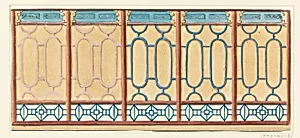
Design for Fretwork, perhaps for the glass passage
1803 or earlier
Classification
interiors
Department
Smithsonian Collection
Museum
Smithsonian American Art Museum
Credit
Museum purchase through gift of Mrs. John Innes Kane
Accession Number
1948-40-51
Rights
Public Domain
About this artwork
Research in Progress
Art Historical Context
Frederick Crace’s “Design for Fretwork, perhaps for the glass passage” offers a glimpse into the refined world of early-nineteenth-century British interior decoration. Created in 1803 or earlier by the English designer Frederick Crace (1779–1859), the drawing presents an intricate pattern intended for openwork carving or latticework. Such fretwork was often employed to filter light and add delicate ornament to transitional spaces like conservatories or glazed corridors. Crace was a leading figure in Regency-era design, known for his elegant neoclassical and chinoiserie-inspired schemes for royal and aristocratic clients. Although the medium of this particular sheet remains unrecorded, the work belongs to the long tradition of architectural drawings that guided craftsmen in translating paper ideas into wood, plaster, or metal. Its classification among “interiors” highlights how even small ornamental details contributed to the overall harmony of a room. Acquired by the Smithsonian American Art Museum, the design reminds visitors that the beauty of historic spaces often rests in these carefully planned, yet rarely seen, preparatory studies.