
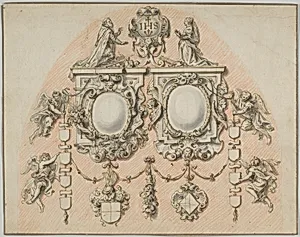
Design for the Epitaph of the 't Seraets-Van Etten family
ca. 1650–75
Medium
Pen and brown ink, black chalk, red chalk, gray wash and heightened in white [oxidized]
Dimensions
Sheet: 9 3/16 × 11 11/16 in. (23.3 × 29.7 cm)
Classification
Drawings|Ornament & Architecture
Department
Drawings and Prints
Museum
Metropolitan Museum of Art, New York, NY
Credit
Frits and Rita Markus Fund, 2014
Accession Number
2014.658.2
Rights
Public Domain
Tags
Art Historical Context
Abraham van Diepenbeeck a prominent Flemish artist of the 17th century associated with Peter Paul Rubens' workshop, created this intricate design around 1650–75 as a preparatory drawing for the epitaph of the ' Seraets-Van E family. Epitaphs like this were elaborate memorial slabs often placed in churches, blending portraiture, heraldry, and architecture to honor deceased families. This sheet captures figures of men and women—likely family members—alongside insignia such as coats of arms, reflecting the era's emphasis on lineage and piety in Baroque art. Executed in a rich mixed-media technique, the drawing employs pen and brown ink for precise lines, black and red chalk for modeling forms, gray wash for subtle shading, and white heightening (now oxidized) to create luminous effects. These methods were hallmarks of Flemish draftsmanship, allowing artists to visualize complex ornamental and architectural schemes before committing to stone carving or engraving. Van Diepenbeeck's mastery shines in the delicate interplay of light and texture, evoking the grandeur of 17th-century memorials. Housed in the Metropolitan Museum of Art's Drawings and Prints department, this work offers a window into the collaborative world of Antwerp's artistic elite, where designs like this bridged painting, printmaking, and monumental sculpture. It underscores the cultural importance of family commemoration in the Dutch Golden Age, blending personal devotion with opulent decoration.