
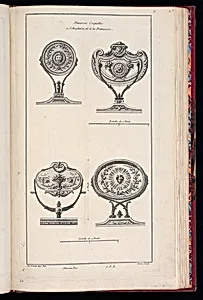
Designs for Carved Decoration for Stagecoaches
Medium
Classification
Department
Smithsonian Collection
Museum
Smithsonian American Art Museum
Credit
Purchased for the Museum by the Advisory Council
Accession Number
1921-6-331-67
Rights
Public Domain
About this artwork
Research in Progress
Art Historical Context
In the late 18th century, France's aristocracy traveled in style aboard opulent stagecoaches, like Richard de Lalonde intricate patterns to adorn these vehicles. Active from 1780 to 1796, Lalonde produced this set of *Designs for Carved for Stagecoaches* 1775 and 1788. Rendered as a print—a medium ideal for precisely reproducing detailed motifs for coachbuilders—these works capture the era's fascination with elaborate craftsmanship, blending functionality with luxury. Stagecoaches were more than transport; they were rolling status symbols, their carved panels showcasing floral swags, mythological figures, or geometric motifs that reflected the refined tastes of the pre-Revolutionary elite. Lalonde's designs highlight the intersection of decorative arts and mobility, offering templates that could be scaled for wooden panels, evoking the grandeur of royal processions. Now housed in the Smithsonian American Art Museum, purchased by the Advisory Council, these prints offer a window into 18th-century design innovation. Though research continues, they remind us how everyday objects became canvases for artistic expression, influencing coach aesthetics across Europe and beyond.