
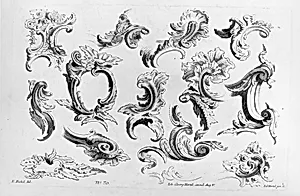
Designs for Rocaille Motifs
mid- 18th century
Classification
Department
Smithsonian Collection
Museum
Smithsonian American Art Museum
Credit
Purchased for the Museum by the Advisory Council
Accession Number
1921-6-300-8
Rights
Public Domain
About this artwork
Research in Progress
Art Historical Context
**Designs for Rocailleifs** Emmanuelichel (1717–1782), a German artist active during the mid-18th century, created these intricate *Designs for Rocaille Mot* at the height of the Rococo era. Rococo, flourishing across Europe from the 1730s to 1760s, emphasized playful asymmetry, scrolling curves, and nature-inspired ornamentation like shells—known as *rocaille*. As a print from the Smithsonian American Art Museum's collection, these designs likely served as pattern books for artisans crafting furniture, wallpaper, silverware, or architectural details, reflecting the era's lavish decorative arts. Eichel's work captures the whimsical essence of German Rococo, seen in opulent palaces like those in Bavaria and Saxony. Prints like these were essential tools, allowing motifs to spread widely among craftsmen without the need for original drawings. Though the exact medium remains under research, such designs typically involved etching or engraving, enabling precise replication of fluid, organic forms that evoked movement and delight. Acquired for the museum by the Advisory Council, these motifs highlight Rococo's cultural shift toward interior luxury and fantasy, bridging fine art and everyday elegance. Visitors can imagine them adorning a grand salon, where every curve invited the eye to wander. (198 words)