
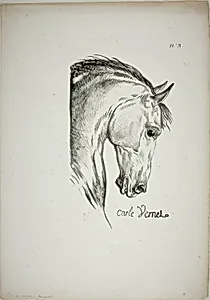
Detail of Horse's Head, Enlarged to Triple Size, Norman Royal Guard, No. 3
c. 1818
Medium
Lithograph in black on ivory wove paper
Dimensions
Image: 24.8 × 14.6 cm (9 13/16 × 5 3/4 in.); Sheet: 42.3 × 29.7 cm (16 11/16 × 11 3/4 in.)
Classification
lithograph
Department
Prints and Drawings
Museum
Art Institute of Chicago
Accession Number
40048
Rights
Public Domain
Art Historical Context
Carle Vernet, a masterful French artist renowned for his dynamic depictions of horses and military scenes, created this striking lithograph around 1818. Titled *Detail of Horse's Head Enlarged to Triple Size Norman Royal Guard, No 3*, it zooms in dramatically on the noble head of a steed from the Norman Royal Guard series, capturing its alert expression, flowing mane, and muscular form in fine black ink on ivory wove paper. Measuring just 24.8 × 14.6 cm for the image, this print exemplifies early lithography—a revolutionary technique invented two decades earlier that allowed artists like Vernet to achieve unprecedented detail and tonal subtlety through greasy crayon drawings transferred to stone. Vernet's work reflects the Bourbon Restoration era in post-Napoleonic France, when royal guards like the Norman contingent symbolized monarchical revival and equestrian prowess. As a pioneer in lithographic horse portraits, he elevated the medium from mere reproduction to artistic showcase, blending realism with dramatic flair. This enlargement invites viewers to appreciate the anatomy and spirit of the warhorse, a motif central to Vernet's career amid Europe's shifting military landscapes. Housed in the Art Institute of Chicago's Prints and Drawings Department, this piece offers a window into 19th-century printmaking innovation and the cultural reverence for equine power in royal service.
About the Artist
Carle Vernet · 1758–1836
Comment on works: Horses; Landscapes; History; Battles