
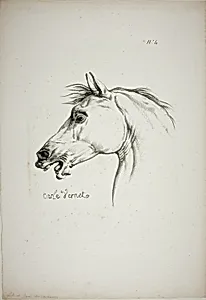
Detail of Horse's Head, Enlarged to Triple Size, Norman Royal Guard, No. 4
c. 1818
Medium
Lithograph in black on ivory wove paper
Dimensions
Image: 19.6 × 20 cm (7 3/4 × 7 7/8 in.); Sheet: 42.9 × 29.3 cm (16 15/16 × 11 9/16 in.)
Classification
lithograph
Department
Prints and Drawings
Museum
Art Institute of Chicago
Accession Number
40053
Rights
Public Domain
Art Historical Context
In the early 19th century, artist Carle Vernet renowned for his masterful depictions of horses and military scenes, captured the noble spirit of equestrian life in this striking lithograph, *Detail of Horse's Head Enlarged to Triple Size Norman Royal Guard, No 4* (c. 1818). Part of a series showcasing the steeds of the French royal guard during the Bourbon Restoration, this close-up magnifies the horse's head to heroic proportions, highlighting Vernet's keen eye for anatomy and expression. The "Norman" likely refers to a robust breed favored for its strength in guard duties, evoking the grandeur of post-Napoleonic France. Printed in black ink on creamy ivory wove paper, this lithograph exemplifies one of the medium's earliest triumphs. Invented just two decades prior, lithography allowed Vernet to translate his dynamic sketches into precise, reproducible images with a painterly softness—greasy crayon on stone yielding rich textures in the horse's mane, alert eyes, and flared nostrils. Measuring a compact 19.6 × 20 cm, the image punches above its size, making fine details accessible to a wider audience. Housed in the Art Institute of Chicago's Prints and Drawings Department, this work reveals Vernet's influence on Romantic equestrian art, blending realism with drama. Visitors can almost hear the horse's snort, a testament to how prints democratized elite imagery in an era of political transition.
About the Artist
Carle Vernet · 1758–1836
Comment on works: Horses; Landscapes; History; Battles