
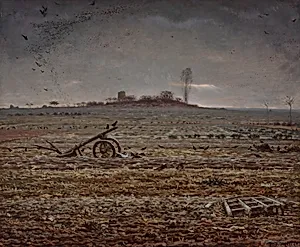
Die Ebene von Chailly mit Egge und Pflug
Medium
Öl auf Leinwand
Dimensions
60,3 × 73,6 cm
Classification
Gemälde
Department
Belvedere Collection
Museum
Belvedere
Credit
Belvedere, Vienna
Accession Number
2450
Rights
Public Domain
Art Historical Context
Jean-François Millet’s *Die Ebene von Chailly mit Egge und Pflug* (The Plain of Chailly with Harrow and Plow), painted in 1862, captures a quiet moment on the rural plains near Barbizon, France. As a leading figure of the Barbizon School and a pioneer of Realism, Millet turned his attention to the unvarnished lives of peasants and the land they worked. This modest oil on canvas (60.3 × 73.6 cm) reflects the movement’s emphasis on direct observation of nature and the dignity of agricultural labor during an era of rapid industrialization. The composition centers on simple farming tools—an iron harrow and plow—resting against the vast, furrowed earth, inviting viewers to contemplate the relationship between human effort and the landscape. Millet’s earthy palette and textured brushwork convey the weight of the soil and the quiet endurance of rural life, elevating an ordinary scene to one of quiet monumentality. Now part of the Belvedere Collection in Vienna, the painting demonstrates Millet’s international influence and the enduring appeal of his sympathetic portrayals of the countryside. It remains a compelling reminder of 19th-century debates about what subjects deserved artistic attention.
About the Artist
Jean-François Millet · 1814–1875
Jean-François Millet (1814-1875) was a French painter and one of the founders of the Barbizon school, whose dignified depictions of peasant laborers transformed how art could represent rural life. His monumental images of sowers, gleaners, and field workers elevated common people to subjects previously reserved for mythological or historical figures, making him a pivotal figure in the development ...