
Die Loge Johannis
1873
Medium
Öl auf Leinwand
Dimensions
320 x 208 cm
Classification
Gemälde
Department
Belvedere Collection
Museum
Belvedere
Credit
Belvedere, Vienna
Accession Number
2083
Rights
Public Domain
About this artwork
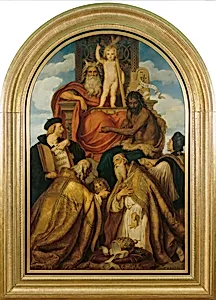
Das Bild entstand in Stuttgart, wo Canon seit 1869 lebte. Der Erfolg dieses Bildes auf der Wiener Weltausstellung von 1873 bewog Canon allerdings, wieder endgültig in seine Heimatstadt Wien zurückzukehren. Das Bild stellt eine Aufforderung zur Versöhnung zwischen den Konfessionen dar: Auf dem Thron sieht man Moses mit den Gesetzestafeln links und dem Pentateuch auf den Knien. Auf diesem steht das Christuskind mit dem Kreuz in der Hand. Ihn begleitet Johannes der Täufer, der mit der Hand auf die ...
Art Historical Context
**Die Loge Johannis** (The Lodge of John), painted by Austrian artist Hans Canon in 1873, is a monumental oil on canvas measuring 320 x208 cm, now housed in Vienna's Belvedere Collection. during Canon's residence in Stuttgart since 1869, the work gained immense acclaim at the 1873 Vienna World Exhibition prompting his permanent return to his hometown. This grand painting embodies the historicist spirit of the 19th century, blending symbolism with a plea for unity amid Europe's divided faiths. At its heart, the composition depicts a profound call for reconciliation between Judaism and Christianity, as well as among Christian denominations. Moses enthroned holds the Ten Commandments and Pentateuch, upon which the Christ Child stands grasping a cross. John the Baptist gestures toward the Bible verse "Love one another" in the hands of a Protestant preacher, while an Anglican cleric presents a scroll. Kneeling humbly at John's feet are the Pope—sans tiara—and the Orthodox Patriarch removing his crown, symbolizing submission to shared spiritual ideals. Canon's triangular arrangement draws from the Italian Renaissance tradition of *Sacra Conversazione*, evoking intimate yet sacred dialogues among holy figures. Its altarpiece-like scale and dramatic grouping underscore a message of ecumenical harmony, making this a culturally resonant artifact of post-Enlightenment religious aspirations.